Two weeks of setup. A first draft that scored 100% on an AI detector. The fix wasn't a sharper prompt. It was a style guide built from my own edits, and a loop that keeps getting closer.
So when I first got my x5 Claude subscription, the 5× Max plan, I spent two weeks getting ready to write my first article. Tried everything the internet tells you to do, so I made a few skills, even set up a copywriting agent, after researching tons of GitHub repos, went the "you are an expert" route, gave it instructions to read the guides on how not to sound like an AI from Wikipedia. After putting weeks of setup into the first draft surely it should come out right... right? Wrong.
The first draft came out beyond bland and robotic. It read like something with the life taken out of it, like it was forced to sit down at a typewriter. After I ran it through an AI detector to confirm what I already knew, the results were obviously 100% AI generated. Felt like all that preparation I put into it was for nothing. Sat there thinking, I cannot publish this. So now what, what's my next step.
The setup was never the goal
Even after all the effort and research you put into building a good setup, none of it can emulate your voice, your experience. So you can stack every best practice onto the model (the skills, basically a saved instruction set; the agent, a sub-assistant with its own brief; the expert prompt, plugins, you name it), and it will still hand you a competent lifeless text that reads like everyone else's competent skeleton. But, despite my initial reaction, all the prep wasn't all wasted. It just wasn't doing what I thought it would do, which was hand me over a masterpiece: SEO optimized, quirky, fun, engaging, knowledgeable and professional. Basically one-shot my number 1 ranking on Google.
Which I mean, jokes on me for even thinking I could do something like that. I find comfort thinking I'm not the only one who walked into this having big hopes, and then being crushed by the reality of actually delivering something viable.
What I can safely say is that your voice isn't a prompt problem. Unfortunately you can't instruct your way into it, you can't outsmart your identity into a system. Maybe not yet, who knows. Personally I've been treating it like a configuration step, and nothing more. "If I set it up well enough up front then for sure the output arrives sounding like me." Surprise, surprise, it doesn't work like that at all. Voice doesn't live in the setup or preparation you make. It lives in the edit, so no amount of prompting the perfect skill will outperform your authentic self.
How I built the style guide from my own edits
Sat down in the editor, took a long look at the text in front of me and went for it, phrase by phrase, rewriting it in my own words. Somewhere in there, it turned. I realised that what I'd been given wasn't wrong. It was actually a proper bone for my own ideas, just with the me factor missing from it. The logic between the ideas held, surprisingly well. The flow and the continuity were genuinely good, like I could see myself reading it in a different polished version and actually enjoy it. It was the delivery that was plain and boring to read through.
Which ultimately made the editing easy instead of demoralizing. A backbone to write on top of makes it simple to come up with more ideas or other personal takes, so as I went through it I started adding thoughts that weren't in the draft at all, thoughts I only reached because the structure was there to push against and make me give more context where my prompting failed. At some point I locked in and realized I'd been in flow for a while, fully in editor mode. Not the giving-up I'd expected walking into this, to be honest.
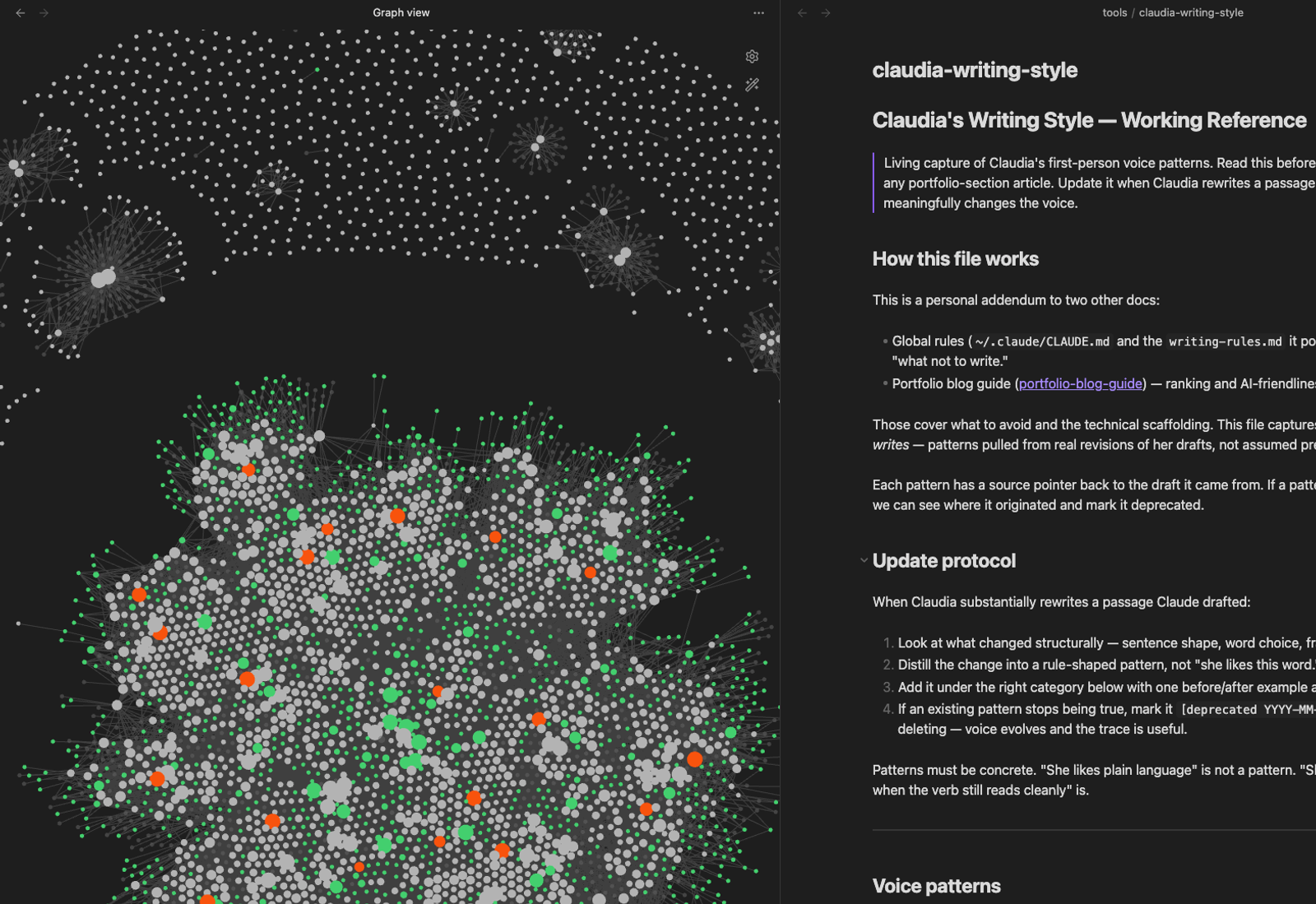
And when I was done, the fun part came: I asked Claude to put the two versions side by side, line by line, what it wrote against what I wrote, and then turn those insights into a document we could use moving forward. Named the file on its own, something like claudia-writing-style, and then pulled my tone out of the comparison. The point was an AI style guide that grows: a file of rules pulled straight from my own edits, getting sharper as I write more articles, which makes me a better writer and makes Claude better at sounding like me. That's the exchange.
Now, on being handed a list of your own verbal tics
What came back surprised me, sort of but not really. A lot of people love to notice my tics, so having Claude not focus solely on the exact tone I have, but point out the specifics of my way of speaking... was interesting to say the least. One thing is for a person to point it out. In time you just end up rolling your eyes, saying "yeah, yeah, I know," now back to what I was saying. But when an AI outlines it, it's like you pay more attention.
I'm a Romanian native speaker, so my way of speaking English is built a little differently. Friends from abroad, especially native speakers, notice the way I combine words and we've gone into long analyses over the semantic logic I use versus theirs. I knew this loosely, but seeing it named in a document was a completely different thing. There were the linguistic decisions I make without even thinking: dropping the "I" at the start of a sentence, explaining a term inline with a quick "basically" so nobody's left behind, circling everything back to the client's experience (in reference to this article I tested out) because that's what actually drives every decision I make, so having more context around their experience helps me express myself. And, oho, the verbal tics. I call them automated linking words, little connectors that let me move between ideas faster, but some would like to disagree with my way of presenting them as elegant quirks. If they show up in my English, well, in Romanian it's worse. They're a bit annoying but at this point I've made peace with them as part of who I am.
The weird part isn't having tics. Everyone has tics. It's being handed an accurate list of your own, by a machine, that you can't really argue with, so all you can do is sit there, read and nod. Hm, I really do say "basically" a lot.
When the work moved from daunting to actually enjoyable
There's a line in Ann Handley's Everybody Writes that names what I experienced: "AI increasingly helps us be more creative and strategic, letting us focus on the parts we love while outsourcing the stuff we don't." For me it landed as something sharper. The bottleneck moves from generation to judgment. That's exactly the shift with recent developments in incorporating AI into our workflows. Instead of pulling all my energy into inventing every part of the piece, like I needed before, I now put it into selecting, judging, curating what feels right. It's a new way of working and it feels liberating.
It helps to know where the relief comes from. When I was in art school, in our painting classes, we'd step away from a canvas for a few days on purpose. Prolonged immersion makes you lose your grip, so you stop being able to see what the painting actually communicates, because you've been inside it too long, focused on getting all the details right. You have to come back with new eyes. Generating ideas and content was the part where I never got to step away, and then successfully come back. I'd disappear into producing, dread the whole process because my mind could plan better than execute, and eventually give up on any kind of consistency. Moving the weight onto judgment gives me the new eyes without the days away. The base for my work is already there. My job is to look at it honestly and decide what's true to me and what isn't.
Whether any of this is a good idea, I'm not sure
Would I tell another designer to stop pasting raw output from their AI models onto their blog? To that I say, each to their own. At the end of the day, nothing I can say stops it, and there's already enough data to see where this goes. The internet fills with impersonal AI content to a point of no return, and that content gets buried in its own noise. I think that what survives in the conditions we created is the work where a person's qualia, their felt experience, is fused with the freedom these tools genuinely give you. So it's less a rule and more a question of where you want your work/practice to live. Cleaning up a digital footprint that's already flooded with general, impersonal content doesn't sound too good to me.
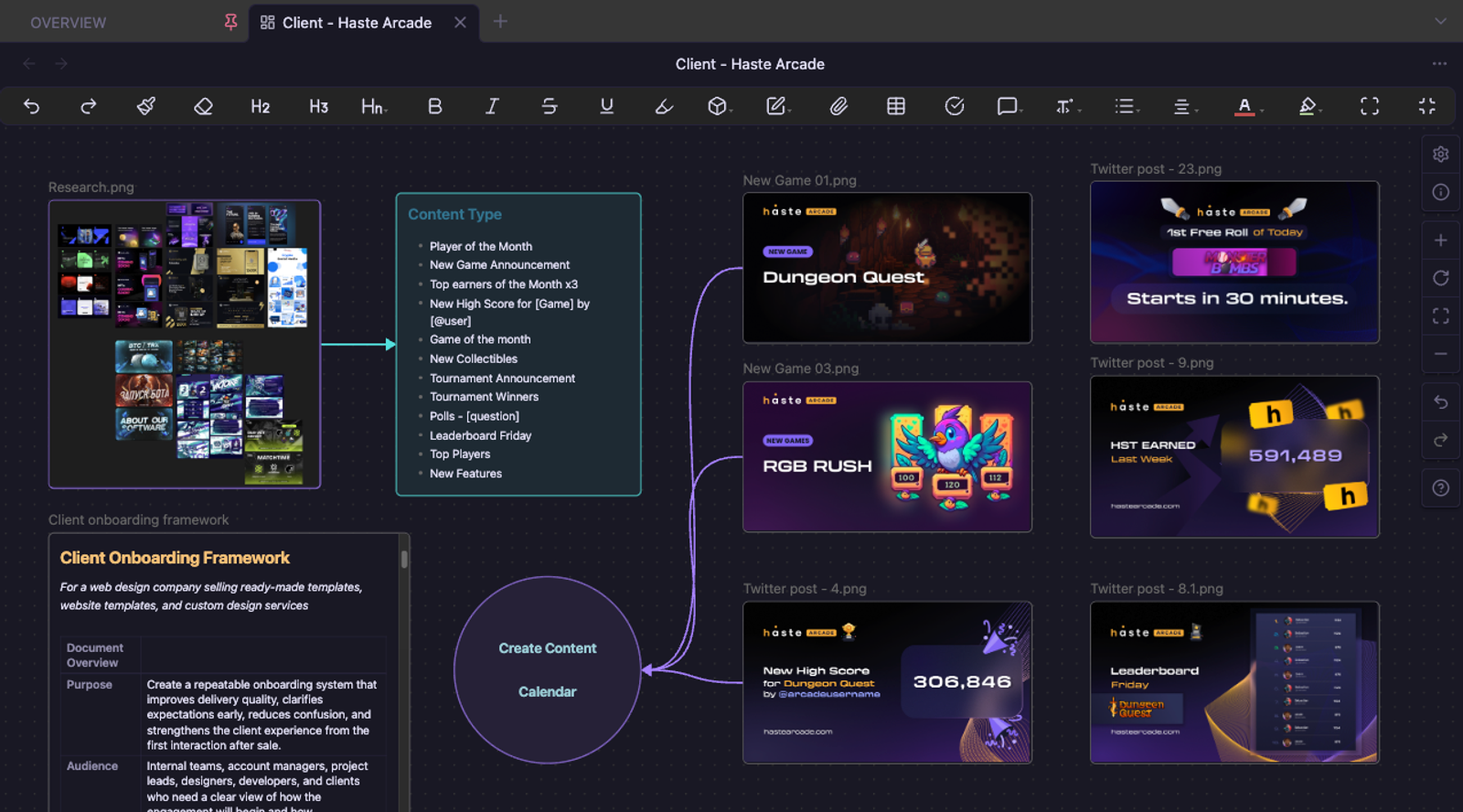
But is owning your voice the same fight as owning your files, the argument I made for keeping my brand-strategy work in Obsidian Canvas instead of FigJam? Not exactly, and this is where I get less certain. My instinct on intellectual property is that in an ideal world it would flow more freely than it does. My own voice is one small layer in the general creative output of the human species, most likely minor beyond my comprehension, but still part of it. People fight so hard over these things mostly because their livelihoods depend on it. If my creative voice can put food on the table, that's because this is just how the economy is set up right now. Which means yes, what I'm doing might be a little absurd: feeding an AI my own way of writing, letting it generate good drafts off the drafts we make, editing them back toward myself, publishing the result. A long experiment in how well a voice transfers into a system run by a machine. To me that's pretty exciting. That's where I've focused my current work while the noise keeps rising. More so as a self-discovery process.